Photo Friday: The Lion of Venice


Here in the centre stand the glass.  Light
Is the lion that comes down to drink. There
And in that state, the glass is a pool.
Ruddy are his eyes and ruddy are his claws
When light comes down to wet his frothy jaws.
-- Wallace Stevens, "The Glass of Water"
The pride of lions -- stone and otherwise -- in Venice numbers in the thousands. For centuries the king of the beasts has served as the emblem of Italy’s gem of the sea. Lions are proud, regal, and powerful creatures -- all characteristics of Venice past and present. But the roots of Venice’s most prevalent symbol are tangled in religious tradition.
Because until more recent centuries most people were illiterate, symbols were used to signify the important figures in the Bible and to help tell the important stories about these people.
  • Matthew: an angel or a winged man
  • Mark: a lion
  • Luke: an ox
  • John: an eagle
  • Jesus: a lamb
The lions in Venice symbolize St. Mark -- the same St. Mark for whom San Marco, Venice’s most important church is named. San Marco houses the remains of St. Mark. In 828 AD a group of Venetians went to Alexandria, Egypt and stole the saint’s relics and brought them back to Venice. San Marco was then built to hold Venice’s most important religious treasures. And the symbol of St. Mark, the lion, came to also symbolize the power and pride of the city as well.

Venice’s lion appears in a variety of media and forms from a mewling kitten to a menacing male. It is often, though not always, depicted holding a book which reads, "Peace to you, Mark, my evangelist." On each trip I take, I choose a photographic theme, and my theme for this trip was Venice’s lion. When I started to look closely, I found that lions stalk every campo, corte, and calle in Venice.

So, I have created a slideshow of some of the photos from my lion hunting in Venice.  Enjoy!


Visit DeliciousBaby.com for more great Photo Friday treats!

Must See Museums: The Louvre in Minneapolis


What a fall for art in the US! I've previously blogged about finding Michelangelo in New York and Ft. Worth as well as Caravaggio in Chicago. Well, now add Minneapolis to your list of cities to visit this fall.

Personally, I love Minneapolis -- the sculpture garden, the Minnesota Orchestra, the downtown Dayton's (now Macy's) -- Minneapolis is a fabulous city. And this fall there's one more reason to love Minneapolis: the Minneapolis Institute of Arts is host The Louvre and the Masterpiece, a special exhibit. Featuring works by greats including Georges de La Tour, Johannes Vermeer, Leonardo da Vinci, and Michelangelo amongst others, the exhibit explores one of art's enduring questions: why is this piece better than that one?

The exhibit opened October 18 and is on until January 10, 2010. I'm headed there in November, and you can expect a full report!

Prices:
  • $16 Adults, weekends
  • $14 Adults, weekdays (including Thursday nights)
  • $12 Students, seniors, adult groups
  • $8 Children 6-12
  • Free to children 5 and under, student and children's groups, and members

Freebie: 
You can download the exhibit audioguide from the MIA website for FREE! That's right! You can rent it at the museum for $4 or download it before you go and listen on your phone or iPod for free. Very cool!

In reference to: MIA - The Louvre and the Masterpiece (view on Google Sidewiki)

* Images courtesy of the Minneapolis Institute of Arts.

St. Crispin's Day


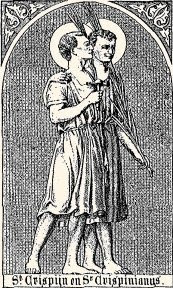
Today marks St. Crispin’s Day -- a commemoration of two saints, actually: Crispin and Crispinian. According to tradition both men were shoemakers who were martyred at Soissons at the end of the 3rd century. But I don’t generally think of shoes or shoemakers on this day... I think of one of my favorite high school teachers.

In the pantheon of teachers who shaped me into the woman I am today, one of those remarkable teachers was a man we all called “D. Smith” -- our AP European History teacher. D. Smith was a remarkable, creative, and inspiring teacher who respected his students while challenging them to stretch and to grow into true thinkers. Our first assignment in his class was to draw Europe. Yes. He gave us each a blank sheet of paper, and we had to draw a political map of Europe from memory. I did not do very well, but I tell you that by the end of that class I could recite parts of The Leviathan, have an intelligent discussion of the French Revolution, and yes, draw a map that bore a passing resemblance to Europe.
D.Smith referred to us, his AP students, as “the gods of the earth.” He inspired in us a passion for the politics of revolutions, the art and music of empires, and he encouraged each of us to pursue our intellectual curiosities with integrity and vigor.

The day of the dreaded AP exam dawned, and “the gods of the earth” stumbled into the classroom clad in sweatpants and slippers, prepared for hours of writing and analysis, terrified and ready for it all to be over. D. Smith stood before us and instead of wishing us luck, he gave us the world’s best pep talk, borrowing from Shakespeare’s Henry V.

A little context for those who don’t remember Henry V...
It is October 25,1415: St. Crispian’s Day, and England under Henry V is about to face France at the Battle of Agincourt. England is sorely outnumbered, and the English commanders are fretting about their poor odds, but King Henry feels differently.

Westmoreland: O that we now had here
But one ten thousand of those men in England
That do no work to-day!

King Henry V: What's he that wishes so?
My cousin Westmoreland? No, my fair cousin;
If we are mark'd to die, we are enow
To do our country loss; and if to live,
The fewer men, the greater share of honour.
God's will! I pray thee, wish not one man more.
By Jove, I am not covetous for gold,
Nor care I who doth feed upon my cost;
It yearns me not if men my garments wear;
Such outward things dwell not in my desires.
But if it be a sin to covet honour,
I am the most offending soul alive.
No, faith, my coz, wish not a man from England.
God's peace! I would not lose so great an honour
As one man more methinks would share from me
For the best hope I have. O, do not wish one more!
Rather proclaim it, Westmoreland, through my host,
That he which hath no stomach to this fight,
Let him depart; his passport shall be made,
And crowns for convoy put into his purse;
We would not die in that man's company
That fears his fellowship to die with us.
This day is call'd the feast of Crispian.
He that outlives this day, and comes safe home,
Will stand a tip-toe when this day is nam'd,
And rouse him at the name of Crispian.
He that shall live this day, and see old age,
Will yearly on the vigil feast his neighbours,
And say 'To-morrow is Saint Crispian.'
Then will he strip his sleeve and show his scars,
And say 'These wounds I had on Crispian's day.'
Old men forget; yet all shall be forgot,
But he'll remember, with advantages,
What feats he did that day. Then shall our names,
Familiar in his mouth as household words-
Harry the King, Bedford and Exeter,
Warwick and Talbot, Salisbury and Gloucester-
Be in their flowing cups freshly rememb'red.
This story shall the good man teach his son;
And Crispin Crispian shall ne'er go by,
From this day to the ending of the world,
But we in it shall be remembered-
We few, we happy few, we band of brothers;
For he to-day that sheds his blood with me
Shall be my brother; be he ne'er so vile,
This day shall gentle his condition;
And gentlemen in England now-a-bed
Shall think themselves accurs'd they were not here,
And hold their manhoods cheap whiles any speaks
That fought with us upon Saint Crispin's day.
To D. Smith and great teachers everywhere: Salute!