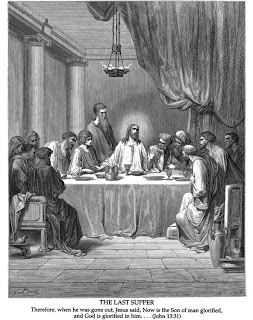
Holy Week in Art: The Last Supper

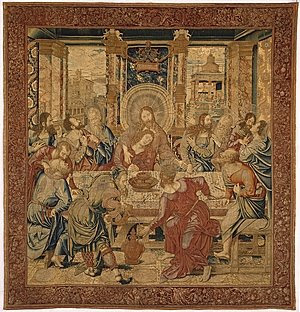
From da Vinci's famous masterpiece in Milan to Ghirlandaio's in Florence, scenes of Jesus gathered at a table with his disciples -- the Last Supper --  are commonplace in Christian art.  In the Christian tradition, today is Maundy Thursday:  the day when the Last Supper is commemorated.  Jesus and his disciples were Jewish and they gathered together for Passover.

During the Sedar meal, Jesus took a piece of the traditional, unleavened bread and gave it to his disciples saying, "This is my body given for you.  Do this in remembrance of me."  He also took a cup of wine and said, "This is my blood shed for you and for all people.  Do this in remembrance of me."  This tradition of sharing the bread and the wine together is the beginning of the Christian practice of Communion.  And it is this moment in the Christian story which is depicted in the Last Supper.  And this is why in many churches children will gather to take their First Communion tonight. 

While there are many more famous depictions of the Last Supper (in Italian  L'Ultima Cena or il Cenacolo), one of my favorites is in the Sistine Chapel in Rome.  When the chapel was completed in 1480, Lorenzo de’ Medici sent Florence's finest frescoists to work on the Sistine Chapel -- a peace offering to the pope. Pietro Perugino, Sandro Botticelli, Cosimo Roselli, Luca Signorelli, and Domenico Ghirlandaio (Michelangelo’s future teacher) drew inspiration from what they saw in Rome as they created the rich and colorful frescoes on the walls.
Like the painters of the Domus Aurea, the Florentine frescoists divided the long space of the Sistine Chapel’s walls with faux architecture, creating form and space from a flat wall. They employed fanciful and imaginative motifs from the Domus Aurea in their paintings, and set the stories they were telling among the ruins of Rome and in buildings resembling the rooms of the Domus Aurea.

Their scheme for the Sistine Chapel reflected the purpose of the room. Below Piermatteo d’Amelia’s blue sky was a tier of ancient popes, reminding the conclave of the historic and spiritual nature of their electoral task. Beneath the row of popes, in a band that extends all the way around the chapel, the painters depicted scenes from the lives of Moses and Jesus, the two most important figures in the Old and New Testaments. Each event from Moses’s life was paired with one from Jesus’s life, illustrating the parallels between their lives. The cycle continued around the chapel, with each panel facing the corresponding panel on the opposite wall. The scheme also drew connections between the Old and New Testaments, the old covenant symbolized by circumcision (The Circumcision of Zipporah) and the new by communion (The Last Supper).
from A Journey into Michelangelo's Rome by Angela K. Nickerson (page 67)
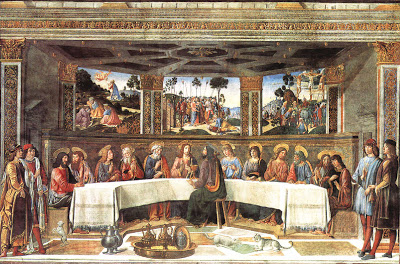
Before I take a group of travelers into the Sistine Chapel, I always talk about what they are about to see -- the dramatic frescoes on the ceiling and the walls -- and the organization of the ideas therein.  Walking into the chapel for the first (or even the hundreth) time is a profound, astonishing event.  But once you stop and look -- truly look -- there are little gems everywhere you look.  And I am particularly fond of Rosselli's Last Supper which is on the north wall of the chapel at the back of the room.

Rosselli depicts Jesus and his disciples at a long, curved table.  Judas, the disciple who betrayed Jesus, sits opposite of Jesus with a small demon perched on his shoulder.  This is all fairly standard fare for a Florentine Last Supper.  But there are also some interesting touches worth a harder look.  In front of the table a cat and a dog are squared off, fighting over a bone.  One one side two gentlemen dressed in Florentine clothing (not Biblical attire) are surveying the scene while on the other side of the fresco two Florentine gentlemen watch the viewer.

But Rosselli does not just limit himself to the events at the Seder table.  If you look out the windows in the composition, other images from Maundy Thursday are apparent:  Jesus and his disciples in the garden and the arrest of Jesus.  After Jesus and his disciples left the meal, they went to the Garden of Gethsemane.  There they spent time in prayer and then Jesus was betrayed and arrested.  If you look closely, you'll see that the soldiers' shields have "SPQR" written on them in the depiction of the arrest.  Jerusalem had been conquered by the Romans, so this is historically accurate, but it may also have been a political dig from a Florentine, too. 
In the third window, Rosselli depicts the Crucifixion, an event which took place the next day and which I'll write about tomorrow.  But tonight as you gather together for a meal whether you are celebrating Holy Week or Passover, I wish you a week that is meaningful and fulfilling.

I Heart... Windows

As I've mentioned before, I try to choose a theme for each trip that I take -- something I photograph consistently which gives my collection of photos from the trip some shape.  On a recent trip to Austria and Germany, that theme was windows.
 
 I focused on what could be seen through windows...
  
 ... as well as the windows themselves.
  
This image shows the smokestacks of the crematorium at Mauthausen, a concentration camp.  
They are reflected in the windows of one of the barracks where the prisoners lived.  
  
I sat outside these windows in Salzburg and listened to a chamber orchestra rehearse.
  
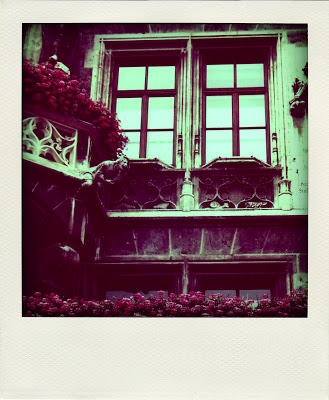
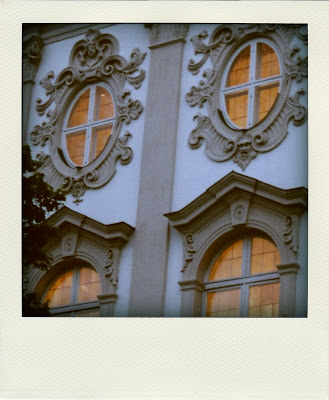
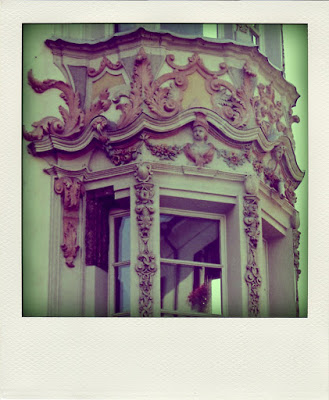
I love the fanciful plaster work on these windows.
  
 And the flowers were all in bloom -- everyone had window boxes.
  
 Even broken windows somehow look prettier in Austria.
  
A note:  I used a tool called Poladroid to turn my photos in to Polaroids.  I learned about Poladroid from Teacher Meets World.  She blogged about how to install and use Poladroid here!  
And how did I find out about Teacher Meets World?  Well, I met her through DeliciousBaby.com's Photo Friday.  Thanks to all of you who joined me from PF, and if you haven't checked it out, do!   

I Heart... Rome in Vegas

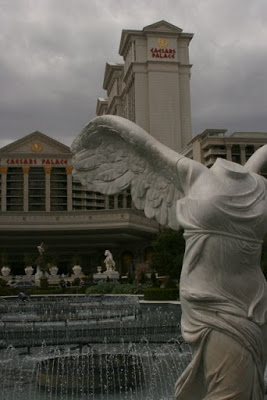
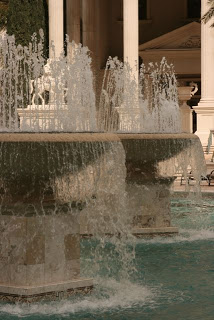
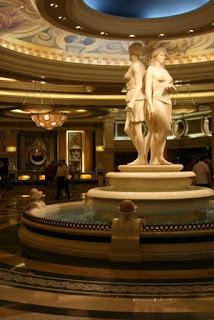
I had never been to Las Vegas before, so when I arrived a few weeks ago, I was completely unprepared.  Honestly, I spent the first day or so in a daze -- complete sensory overload.  But I soon settled in and enjoyed my visit tremendously.  Appropriately enough, we stayed at Caesar's Palace, and I was amused by the Rome-meets-Cheesecake-Factory-in-Shanghai decor.  The hotel is vast, and like all casinos, it strives to meet your every need. 

The hotel opened in 1966 at a cost of $25 million.  Now it boasts more than 2,400 hotel rooms, 100 stores, four heated swimming pools, a spa, nearly 20 restaurants, and a theater featuring headliners Bette Midler and Cher in alternate months.  Oh, and the casino is 150,000 square feet, too! Truly there is something for everyone. 

In addition, Caesar's, like much of Vegas, is partially under construction.  When we checked in we were able to get a better room at a substantial discount (roughly 30% off of rack rate) because we didn't mind a view of the construction project across the way.  However, we did sacrifice in making that choice.  The workers were busy early in the morning to late at night, and the noise at times was inconvenient. 

The sad fact:  Caesar's won't be finishing the construction projects.  Because they are hurting financially, they are only going to enclose the large tower that they are building.  They will build out the rooms and suites at a later date when they have more money.  Such is the state with many of the construction projects in Vegas with rumors that several of the large developers will file for bankruptcy soon. 

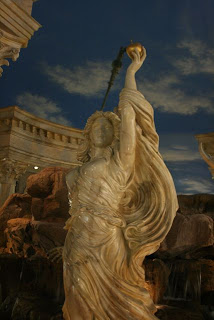
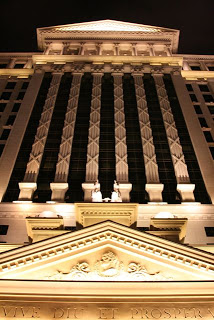
Now, as someone who loves Rome, I had to put away my historical lens and simply appreciate the hotel for what it is:  a fantasy.  Somehow I'd hoped for or expected a Roman bath experience, and at first I was disappointed.  The artistic elements are a mish-mash of ancient Greek and Roman with some Renaissance favorites (like Michelangelo's David) thrown in for good measure.  Clearly, the designers strove for the familiar -- a greatest-hits approach to decorating, so don't expect fine art or historical accuracy.  There is also a tongue-in-cheek approach to the complex which I truly appreciated.  The tower where our room was located, for example, sported the moniker "Vive Diu et Prospera"  -- roughly translated as "Live Long and Prosper." 

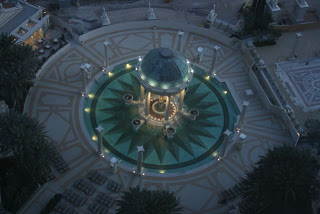
Additionally, the swimming pools are gorgeous!  They are clearly inspired by the pools at Hadrian's Villa outside of Rome.  I spent several afternoons working at the tables by Snackus Maximus (the poolside snack stand), and the sound of splashing water and the warm sun was quite idyllic.  Part of the construction which will be finished is an area called the Garden of the Gods.  Located by the pools, it will be a garden area -- a classical-style oasis in the midst of a large and overwhelming casino.  I look forward to seeing it completed.  

One of the great ironies of Caesar's Palace is its lack of a good Italian restaurant within the casino itself.  Bobby Flay's Mesa Grill has a prime spot off of the gaming floors as does Chef Bradley Ogden's restaurant.  Both are well-known but were beyond our price range for this trip. 

Ironically, the best meal I ate at Caesar's Palace was of the Chinese persuasion.  In fact, I enjoyed my meals at Beijing Noodle No. 9 so much that I ate there three times.  I enjoyed the Kung Pao Chicken -- it was delicious, spicy, and far from the cloying cliche many restaurants serve under the same name.  The dumplings were also delicious with a lovely pork and onion filling and pan-fried just perfectly.  But the noodles are the star at Beijing Noodle No. 9.  They are handmade in the restaurant, and they took me back to my favorite little noodle shop in Korea -- with the same texture but a slightly different flavor.  I'd imagine the restaurant was packed with Chinese gamblers because it offered them a taste of home. 


I'd always heard that Vegas is an inexpensive place to vacation, and to a degree that was true. Our hotel room was luxurious for a relatively low price, and our airfare was very reasonable on Southwest Airlines.  However, because we were on the Strip, our meals and entertainment were costly.  So, in some ways it came out as a wash. 

My biggest complaint about Caesar's Palace is financial, though:  internet service costs $14.95 per day per laptop!  Highway robbery.  I have NEVER stayed in a hotel that charged per laptop.  And frankly these days internet service should be free.  Hear me, Caesar's:  I won't be back based on that fact alone.  Some of your colleagues along the Strip are more generous, and they will get my business in the future. 

Despite the internet costs, Caesar's Palace is worth a visit.  But if you are pinching pennies, you might want to stay somewhere else and just pop over for a visit.