She wakes me with her bells every morning at 7 am. And again at 7:20. And at 7:30. She is rather insistent, actually. “You are in Florence! Get out of bed! Come to see me. Admire my marble. Aren’t I beautiful! The light – it is different this morning, and I am shining in the sunrise. Come see me! Come see my city – she is as beautiful as I am.”
I have always followed instructions well. So I get up! And I go. And I do. And I see.
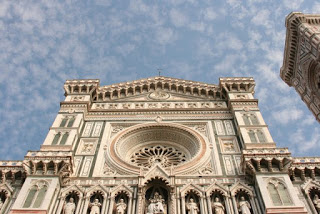
Every path leads me back to her, though. Il Duomo. The Dome. But her nickname does not suit her. She is beautiful, elegant, elaborate. She is more than her dome. She is Santa Maria del Fiore – St. Mary of the Flowers. She is the embodiment of the Immaculate Conception. She has nine doors, and each one is decorated with scenes from the Virgin Mary’s life.
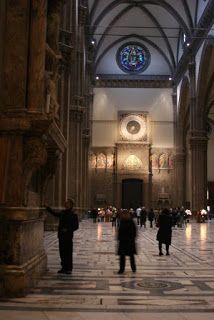
She was designed to be Mary in building form – the place to which we go for comfort, for companionship, and to feel the motherly presence of God. She is enormous, and yet she is filled with light and warmth. And while the city celebrates her dome – the first since antiquity, the wonder of the Renaissance – the faithful gather and light candles for each other. I light a candle for a friend who just lost her unborn grandchild and pray that God our Mother will comfort her in her grief. She has lost a child, too.
 Florence is filled with fleur de lis – the ancient symbol of the immaculate conception. In red on the Firenze flag, carved in stone in the Piazza della Signoria, painted in gold on the illuminated manuscripts in the Museo San Marco… the city proudly proclaims her allegiance to the Virgin Mary. Fra Angelico, Leonardo da Vinci, Cimabue – the great painters of the Renaissance and their predecessors made the city beautiful, decking her in lilies of every ilk. Wandering the streets from leather shop to museum to paper store I follow the lily’s trail.
And then, about 5 pm they start to ring again – the bells of Santa Maria del Fiore.
“Enough,” she says.
“Enough. Sit. Enjoy some wine in that little café over there.” She is motherly and reasonable and loving in her reminders. “That waiter, Paolo, he is sweet on you. Sip some vino di casa, read your book. Watch as the sun slips over me. He does not want to leave me either. Each day it is a struggle. He lingers, bathing me in gold. But, oh, the moon. I love her company. And when the warm sun is gone, the moon and I can join together glowing and silvery on the piazza.”
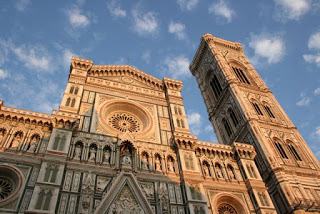
I sit and watch. Her marble skin – red, white, and green – reflects the changing light as the sun sets over the city. She is beautiful. Even in the dark, she draws people to her, shimmering in the moonlight. Night comes, and the people gather before her. They walk past on the way to dinner at Cingale Bianco, or to catch the Rome train at the station, or to indulge in gelato at Grom. She is the flame. We: the proverbial moths.
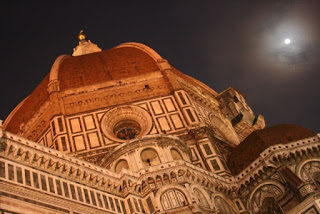 Finally she speaks again. “Sleep,” she says. “I will wake you tomorrow. There are more beauties for you to see. Sleep. God, our Father and our Mother, will watch you. Sleep.”
I leave the windows open, and the slightest scent of lilies fills my dreams.